Table des matières
Zabbix
Encore à faire:
- Icones ?
- Francisation?.
- Surveiller Process
- Surveiller Ping
Zabbix Agent Générer une clé PSK
openssl rand -hex 32
Zabbix Agent sous Linux
wget https://repo.zabbix.com/zabbix/6.2/debian/pool/main/z/zabbix-release/zabbix-release_6.2-4%2Bdebian11_all.deb
dpkg -i zabbix-release_5.2-1+debian10_all.deb
apt update
apt install zabbix-agent

nano /etc/zabbix/zabbix_agentd.conf
Server=10.0.0.213
ServerActive=10.0.0.213
Hostname=Server2
service zabbix-agent restart
Zabbix Agent & LXC Proxmox
Les containers LXC donnent de mauvaises valeurs avec l'agent Zabbix. Une solution existe, pour cela il faut demander à l'agent d'envoyer des données propres au container et créer un template Zabbix dédié pour ces hosts.
Sur le host
- Créer un fichier de configuration pour l'agent
nano /etc/zabbix/zabbix_agentd.d/zabbix_container.conf
Avec les données suivantes:
- zabbix_container.conf
UserParameter=ct.memory.size[*],free -b | awk '$ 1 == "Mem:" {total=$ 2; used=($ 3+$ 5); pused=(($ 3+$ 5)*100/$ 2); free=$ 4; pfree=($ 4*100/$ 2); shared=$ 5; buffers=$ 6; cached=$ 6; available=($ 7); pavailable=(($ 7)*100/$ 2); if("$1" == "") {printf("%.0f", total )} else {printf("%.0f", $1 "" )} }'
UserParameter=ct.swap.size[*],free -b | awk '$ 1 == "Swap:" {total=$ 2; used=$ 3; free=$ 4; pfree=($ 4*100/$ 2); pused=($ 3*100/$ 2); if("$1" == "") {printf("%.0f", free )} else {printf("%.0f", $1 "" )} }'
UserParameter=ct.cpu.load[*],uptime | awk -F'[, ]+' '{avg1=$(NF-2); avg5=$(NF-1); avg15=$(NF)}{print $2/'$(nproc)'}'
UserParameter=ct.uptime,cut -d"." -f1 /proc/uptime
- Relancer l'agent
service zabbix-agent restart
Sur le serveur Zabbix
- Dans le menu Configuration → Template, ouvrez le template 'Linux by Zabbix agent active' et faites un Full Clone et ajouter le nom Proxmox
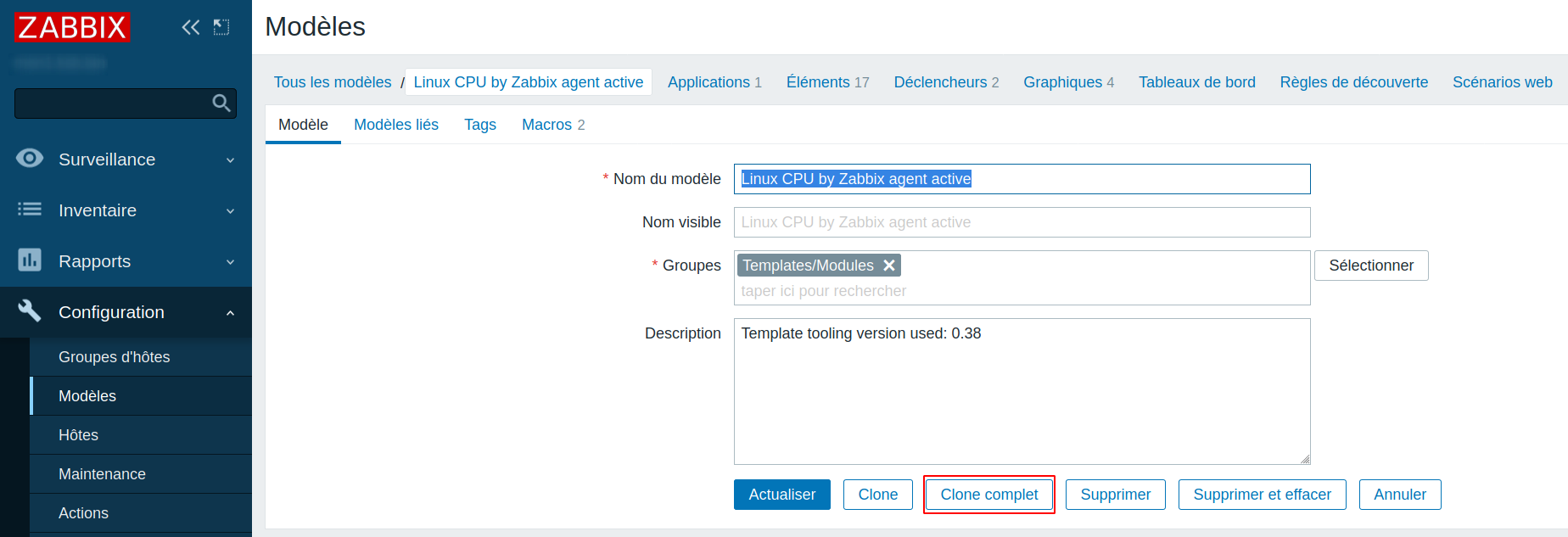
- Réouvrir “Linux CPU by Zabbix agent active PROXMOX” et se diriger dans les Items
- Remplacer system.cpu.load[all,avgX] par ct.cpu.load[all,avg15]
- A présent, ouvrir le template “Linux memory by Zabbix agent active” et faire un Full Clone et rajouter Proxmox
- Réouvrir “Linux memory by Zabbix agent active PROXMOX” et se diriger dans les Items
- Remplacer:
- vm.memory.size[available] par ct.memory.size[available]
- vm.memory.size[pavailable] par ct.memory.size[pavailable]
- system.swap.size[,free] par ct.swap.size[free]
- system.swap.size[,pfree] par ct.swap.size[pfree]
- vm.memory.size[total] par ct.memory.size[total]
- system.swap.size[,total] par ct.swap.size[total]
- Ouvrir le template “Linux generic by Zabbix agent active” et faire un Full Clone et rajouter Proxmox dans le nom
- Remplacer system.uptime par ct.uptime
- Maintenant se rendre dans le template “Linux by Zabbix agent active”, faire un Full Clone en y rajoutant Proxmox dans le nom
- Dans les linked templates, cliquer sur “Unlink & Clear” pour les templates associés CPU, Memory & Generic
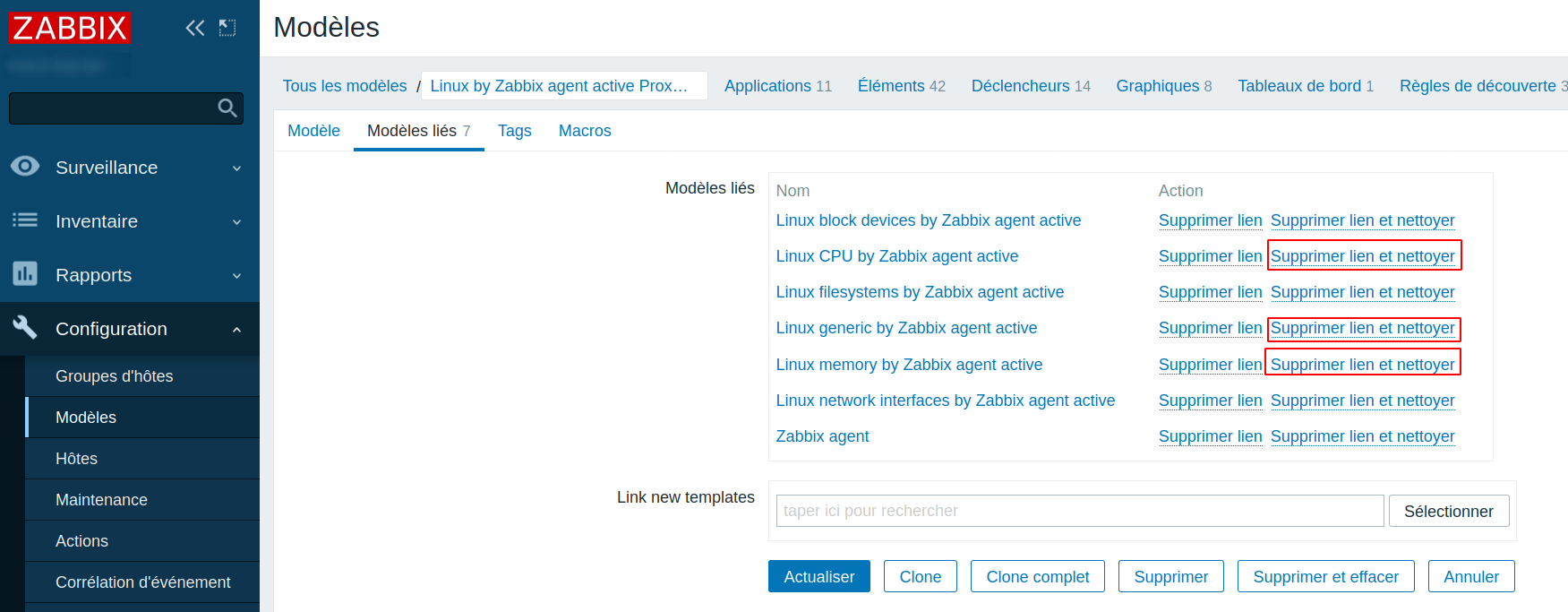
- Rajouter les 3 sous-templates créés
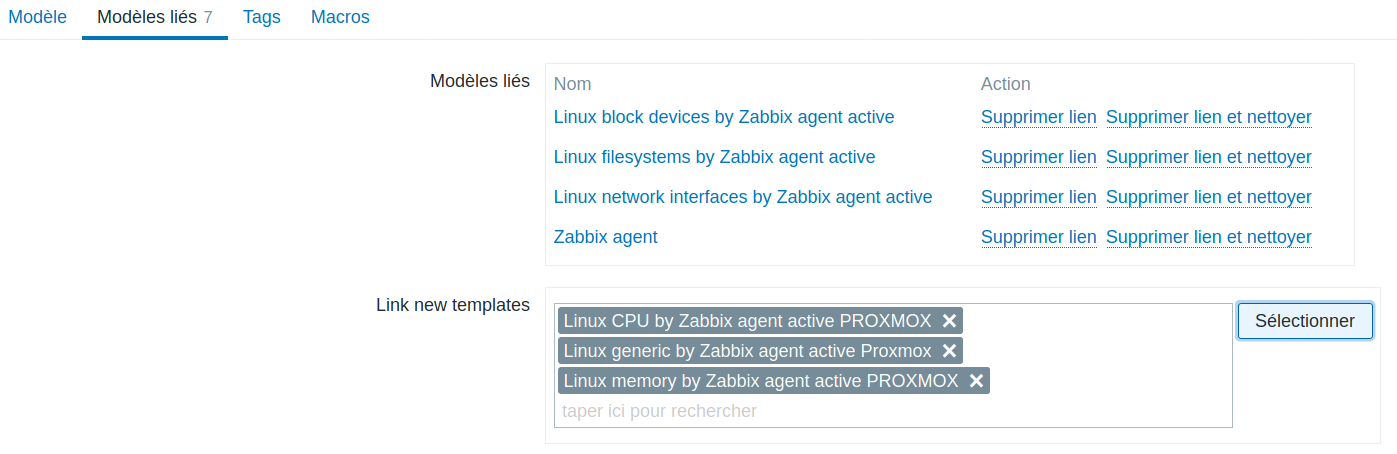
- Affecter le nouveau template “Linux by Zabbix agent active Proxmox” aux machines concernées


Single Sign On (SSO)
- Installer les paquets kerberos nécessaire
apt-get -y install krb5-user libapache2-mod-auth-kerb
- Editer le fichier krb5.conf
nano /etc/krb5.conf
Coller une configuration +/- similaire
- krb5.conf
[libdefaults]
        default_realm = MAKEITSIMPLE.LAN

# The following krb5.conf variables are only for MIT Kerberos.
        kdc_timesync = 1
        ccache_type = 4
        forwardable = true
        proxiable = true

        fcc-mit-ticketflags = true

[realms]
MAKEITSIMPLE.LAN = {
        kdc = srv-ad.makeitsimple.lan
        admin_server = srv-ad.makeitsimple.lan
        default_domain = srv-ad.makeitsimple.lan
}

.makeitsimple.lan = MAKEITSIMPLE.LAN
makeitsimple.lan = MAKEITSIMPLE.LAN
- Faire un test de session
kinit Administrator
- Se connecter sur le serveur Samba-AD et faire les 3 commandes suivantes en modifiant le nom du serveur
samba-tool user create --random-password http-glpi.makeitsimple.lan
samba-tool spn add HTTP/glpi.makeitsimple.lan http-glpi.makeitsimple.lan
samba-tool domain exportkeytab /root/httpd.keytab --principal=HTTP/glpi.makeitsimple.lan@MAKEITSIMPLE.LAN
- Vérifier avec la commande kvno
kvno HTTP/glpi.makeitsimple.lan@MAKEITSIMPLE.LAN
- De retour sur le serveur GLPI, déplacer le fichier dans le dossier apache et lui donner les bons droits
mv httpd.keytab /etc/apache2/
chown www-data:root /etc/apache2/httpd.keytab
chmod 640 /etc/apache2/httpd.keytab
- Editer le fichier apache
nano /etc/apache2/sites-enabled/000-default.conf
- 000-default.conf
DocumentRoot /var/www
 Servername glpi.makeitsimple.lan
 <Location />
                AuthType Kerberos
                AuthName "Demande d'identification SSO"
                KrbAuthRealms MAKEITSIMPLE.LAN
                KrbServiceName HTTP/glpi.makeitsimple.lan
                Krb5Keytab /etc/apache2/httpd.keytab
                KrbMethodNegotiate On
                KrbMethodK5Passwd On
                require valid-user
        </Location>
- Redémarrer apache2
Service apache2 restart
- Ajouter le CA Certificate sur le serveur Zabbix
cp ca.crt /usr/local/share/ca-certificates/
update-ca-certificates<code> puis vérifier <code bash>openssl s_client -showcerts -connect dc1.makeitsimple.lan:636
, la réponse doit être “Verify return code: 0 (ok)”
- Dans Zabbix –> Administration –> Authentification –> Ldap Parameters, faire la configuration pour se connecter à votre DC
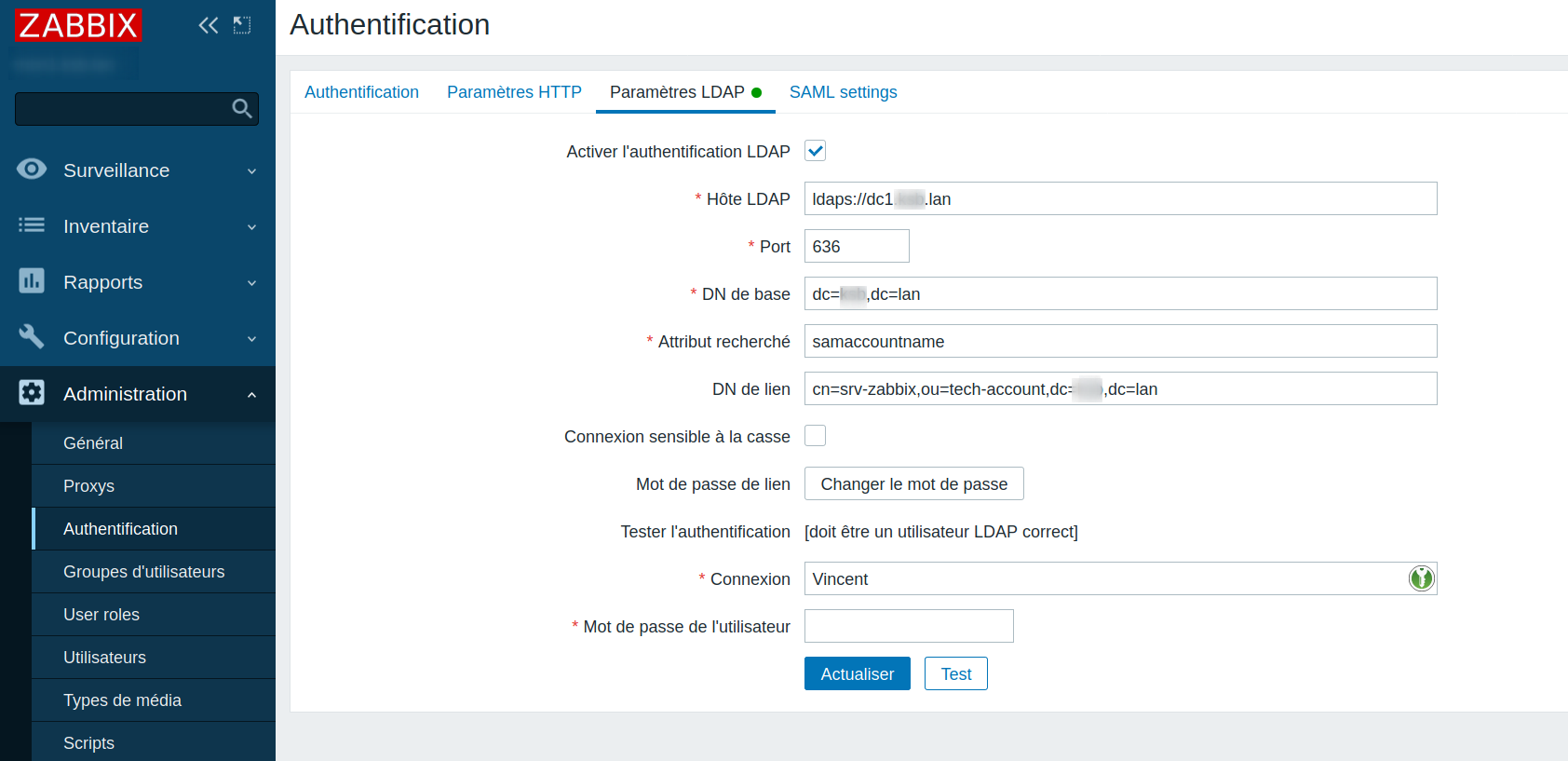
- Zabbix –> Administration –> Authentification –> Authentification –> Choisir LDAP
- Dans Zabbix –> Administration –> Users créer des utilisateurs ayant le même login que sur le domaine. Les mots de passes ne sont pas nécessaires.
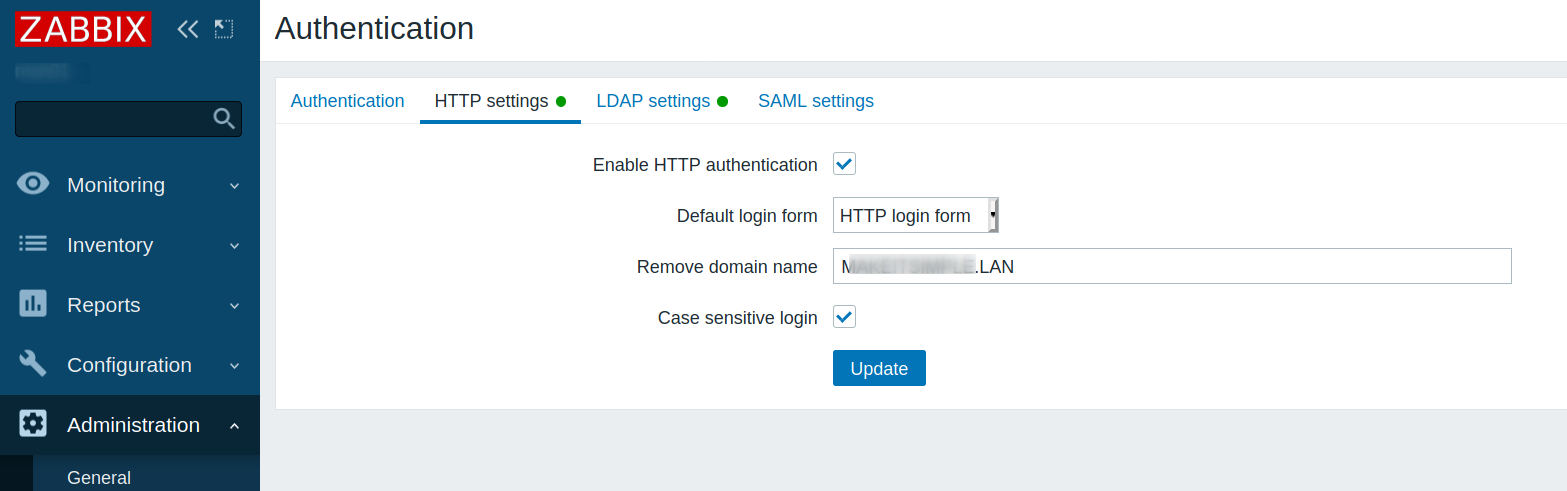
- Dans Administration → Authentication → HTTP Settings modifier les paramètres pour activer le SSO


Les noms de services Windows Dynamiques
Sous Windows, certains services sont générés de manière dynamique et apparaissent/disparaissent selon les besoins. Ceci crée de nouvelles alertes quand ils sont abandonnés par la machine. Pour ce faire, il faut éditer la règle d'exclusion dans Administration > General > Regular Expressions > Windows service names for discovery :
^(MMCSS|gupdate|SysmonLog|clr_optimization.*|DoSvc|sppsvc|MapsBroker|WpnUser.*|OneSync.*|gpsvc|BITS|CDPUserSvc.*|.*KMSELDI|stisvc|UsoSvc|TrustedInstaller|WbioSrvc|tmlisten|ntrts|ntrtscan|CDPSvc|SCardSvr|tiled.*)$

Debugger snmpv3
apt install snmp
snmpwalk -v3 -a MD5 -A PWD -u ciscosnmp -x DES -X PWD -l authPriv 10.10.10.41
Exemples
Ping continu à partir d'un agent
if (Test-Connection server -Count 1 -ErrorAction SilentlyContinue) { write-host "1" } else {write-host "0"}
Sources
- Monitor Process: https://techexpert.tips/zabbix/zabbix-monitor-linux-process/
- Exclude windows services: https://catonrug.blogspot.com/2018/02/disable-some-of-windows-service-check.html
- Fix LXC: